I can’t stop reviewing Jackie Chan movies! Join me for a trip down memory lane as I review 2003’s the Medallion, directed by Gordon Chan.

The Back-story
Crouching Tiger, Hidden Dragon was a fantasy martial arts epic released in May 2000 to critical acclaim and would go on to win numerous awards early in the following year. In 2001, Jackie Chan started production on Highbinders, later known as the Medallion, a fantasy martial arts epic.
Coincidence? Maybe not, but at no point in Chan’s thirty year career had he thought about flying around on wires and dealing with the fantasy genre- unless you count Karate Ghostbusters from 1978.
No, this is Chan’s entry into the fantasy adventure genre, a basic riff on the plot of the Golden Child where Chan plays a secret agent hired to rescue a kidnapped boy with mystical powers.
Although the film is packed with a western cast that includes the late Julian Sands as the bad guy, Claire Forlani, Lee Evans, and is shot in English, this is one of Chan’s Chinese productions, directed by Gordon Chan, who Jackie had previously collaborated with on Thunderbolt in 1995.
This is one of the films of Chan’s early 2000s period that is masquerading as an American film, much like Who Am I and the Accidental Spy, intending to appeal to an international audience and fit in filmmaking-wise with his recent Hollywood productions.
Shot in mid-2001 in between filming commitments for the Tuxedo and Shanghai Knights, it took two years for The Medallion to come to the big screen, after being acquired by Tristar Pictures in 2003, who, a lot like other studios that acquired Chan’s foreign productions, proceeded to hack it to pieces. The Medallion was supposed to be 106 minutes long, but ended up a measly 88 minutes when the final prints had been struck.
The Review
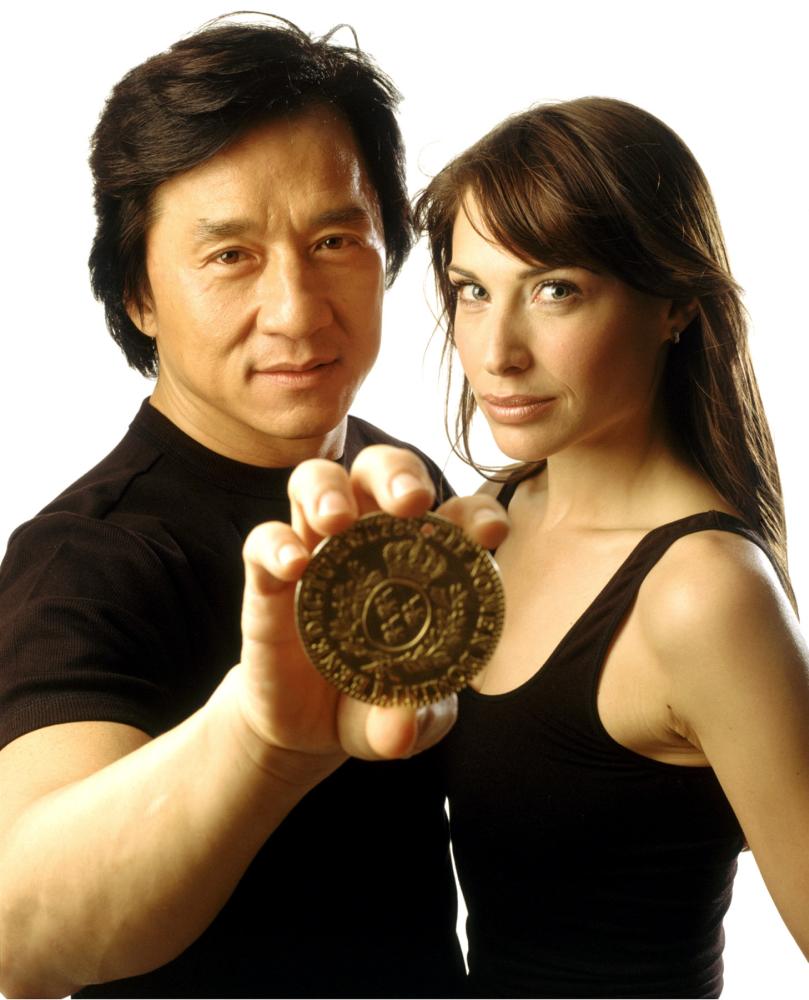
So, what’s the film like?
Well, its…it’s not great.
There are things to like here; the film definitely looks expensive- with a $35 million dollar price tag, it was the most expensive film ever made in Hong Kong up to that point, and with that, the film has an international, globe-trotting scale, with large scale setpieces set both in Ireland and Hong Kong.
Julian Sands is great as implausibly named crime boss Snakehead, although unfortunately a lot of his best villain moments end up on the cutting room floor.
The action in the film is good and pretty much up to the standard of what you’d expect from a Jackie Chan vehicle. As this is a Chinese production, Chan is given a lot more licence to flip about and do daring stunts than he would be allowed to on one of his American films, leading to a great chase scene around Dublin seeing Chan perform some of the best parkour stunts of this era of his career, although, no doubt inspired by Crouching Tiger, there are noticeable bits of wirework during the sequence that will become more prevalent later.
Now, onto the bad. I love Lee Evans and I think he is a very funny stand up comedian, but pairing him up with Chan here just simply didn’t work. He occasionally gets funny moments scattered throughout the film, but the main problem is that he and Chan have absolutely no chemistry whatsoever.
The same can be said of Claire Forlani, Chan’s supposed love interest and co-worker. They’re supposed to have this history together, but they act in scenes together like they’ve just met.
Chinese-Canadian actress Christy Chung pops up here in a supporting role as Lee Evans’ wife, and she is way more impressive action-wise and has substantially more chemistry in her scenes with Chan than Forlani does. As hot as Claire Forlani is, there’s nothing in her role that Chung couldn’t do as well if not better.
The big twist of the film is that Chan is revived by the titular Medallion after a fatal accident where he is drowned in a shipping container whilst attempting to save the mystical boy.
It’s utterly bizarre and defeating to see Chan actually die in a film, and even more bizarre when Lee Evans discovers in the morgue that the Medallion has given Chan supernatural powers that make him virtually indestructible- breaking rule number 1 of screenwriting.
how are we as an audience supposed to root for a character like that?
It’s especially bizarre for Chan, who’s built a career off of being the affable underdog; here, he’s an indestructible super-being who can survive being riddled with bullets and can also fly.
It’s an excuse to get some Wuxia-inspired wire-fu into proceedings. They are well-executed for what they are, but to say it’s not Chan’s strong-suit is putting it mildly.
Even as a Chan fanatic as a kid, The Medallion was one I mostly avoided- it just didn’t seem to deliver any of what I wanted from one of his films, and apart from some neat action in the first half of the film, I discovered I was mostly right. I have no interest in seeing Jackie Chan flying around and using superpowers.
It’s the same problem with the super-powered Tux 1 that Chan uses in The Tuxedo. To be fair, that film is even worse than this, but both films have the fundamental problem of misunderstanding Jackie Chan’s core appeal.
The Irish castle at the end is a nice location for a finale; there is some nice practical stuntwork and effects in his final battle with Julian Sands, and Scott Adkins even pops up as one of Sands’ henchmen, but the fight is a letdown, caked in wirework and is over way too quickly. There was some extended fight stuff in the deleted scenes that was much more in line with Chan’s original style.
The Medallion is a failed experiment in Chan exploring the fantasy and wire-fu genre, but is far from irredeemable- at least they tried something new.
 Burning Arrow Film Blog